It’s been a while since I’ve written anything here. I’ve been mainly focused on my substack and Medium publications The Infinite Universe. I didn’t feel like this topic fit well with those, so I decided to address it here.
Because an episcopal Bishop has been in the news lately, there has been more chatter about Anglicans and their beliefs than usual. This article isn’t about that, however, but about some of the criticisms I’ve been seeing, particularly from Roman Catholics, about Anglicanism.
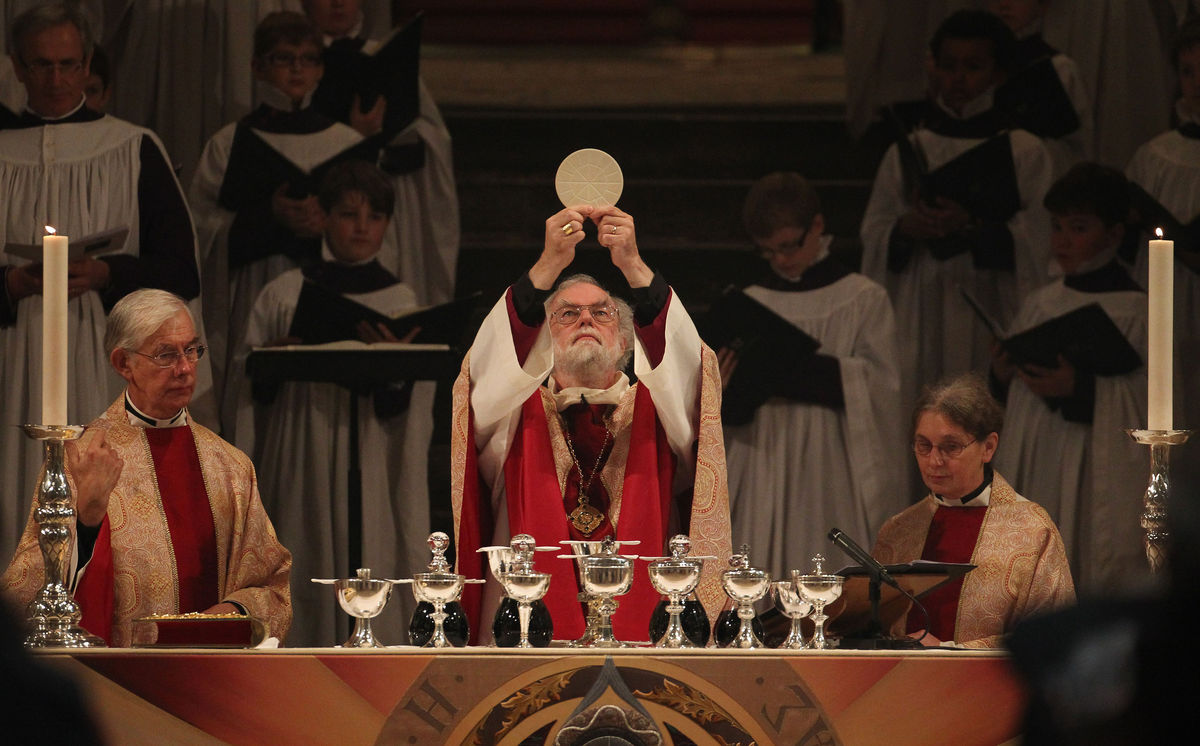
Some RCC members, even clergy, accuse Anglicans, particularly the “high” or Anglo-Catholic variety, of being counterfeit Catholics. This has little to do with our vestments, gothic churches and cathedrals, or even our liturgy, all of which can be virtually indistinguishable from RCC versions.
Because the outward trappings of Anglicanism and the RCC are so similar, it is difficult for Romans to apply their typical polemics against “Protestants” to Anglicans (or even Lutherans or any mainline denomination). Converts from Evangelical denominations and non-denominational forms of Christianity to RC, in particular, don’t often understand Anglican beliefs and assume that only the RCC holds beliefs such as the Real Presence of Christ in the Eucharist, Apostolic Succession, and even the veneration of Mary.
The primary difference between the Anglican and RCC churches is authority. Anglicans believe that authority derives from the “three-legged stool” of Scripture, Tradition, and Reason. The RCC, meanwhile, has over the centuries, especially starting in the 11th, increasingly vested more power over the church into the Papacy. Prior to that time, bishops and archbishops owed as much allegiance to their various Princes, Kings, and Emperors as the Pope. Indeed, the French and Germans were quite aggressive in this regard until the Enlightenment when separation of church and state became more popular. Italian unification in 1870 encouraged the Papacy to assume even more power over the RCC’s bishops since it lost most of its other powers to the emerging Italian state.
While the RCC also acknowledges the authority of scripture and tradition, they believe it is up to the Church, through the office of the Papacy, to interpret what that means. Anglicans tend to rely more on councils of Bishops to make those decisions. The RCC often flirted with this idea during its history, called Conciliarism, only for the Popes to become further invested with power.
It’s important to understand from where authority comes in the two traditions because it is easy for Roman Catholics to make the mistake of assuming that decisions made by, e.g., English reformers such as Thomas Cranmer or Richard Hooker, have some sort of Papal-style authority over what the church believes. Cranmer was dead, burned at the stake for heresy, by the time the founding documents, the 39 articles of the Church of England, were established in 1571 under Elizabeth I.
These days most Anglican clergy are no longer required to agree with the articles. In the Church of England, they agree they are acceptable to God, a sort of historical nod rather than affirmation. In The Episcopal Church of the United States, they are considered purely historical and have no authority.
Nevertheless, Roman Catholics will argue lex orendi, lex credendi, meaning what we pray, we believe.
For example, this article by Roman Catholic Fr. Dwight Longenecker, attempts to analyze the prayer the priest says when handing the host to the recipient,
The Body of Our Lord Jesus Christ which was given for you preserve your body and soul unto everlasting life. Take and eat in remembrance that Christ died for you and feed on him in your heart by faith with thanksgiving.
He argues that this must mean that Anglicans believe this:
They express the Anglican doctrine of receptionism–not that there is an objective transformation at the altar, but that the transformation is dependent on the faith of the recipient.
I’m not sure how Fr. Dwight came to this conclusion, but it is absolutely wrong. He then goes on to say that Anglican clergy must all affirm the 39 articles, which is also wrong, so I can see where his error comes from. If you assume that Anglicanism is just a religion that was made up in the 1530s and 40s, I could see you running to this conclusion.
First of all, the Anglican liturgy explicitly consecrates the bread and wine, after which they are considered to be the Body and Blood of Jesus Christ full stop. This is why Anglicans take enormous care with consecrated Host, just as Roman Catholics do and unlike, e.g., Methodists or other Protestants who no longer believe in an objective transformation of the bread and wine. Consecrated Host cannot be thrown out. It must be consumed or buried. Wine can’t be poured down the sink. (There is a special kind of sink with a pipe going into the ground called a Piscina that can be used for it but often the priest or deacon just drinks all that is left in the cup.)
If Anglicans believed in Receptionism, why go through all this with Elements that haven’t been handed to any faithful recipient?
Since Fr. Dwight decided to quote that particular prayer, here is another prayer, much shorter, which is more commonly said while handing the host to the recipient:
“The Body of Christ, the Bread of Heaven”
Likewise with the common cup of wine
“The Blood of Christ, the Cup of Salvation”.
These affirm the genuine and objective reality that Christ’s Body and Blood are in the bread and wine.
While some Anglican theologians of the reform period may have believed in Receptionism, it’s not always clear what they believed even from what they wrote. The Episcopal Church Dictionary suggests that Thomas Cranmer, who wrote the original Book of Common Prayer, believed this and put it into his version of the Eucharistic prayers, but it’s never really clear what Cranmer believed because he lived during extremely politically charged times and would have had to bow to whoever was in charge of England since they were the ultimate head of the church. One source I consulted suggested Cranmer was a “symbolic instrumentalist” in line with later John Calvin which isn’t quite the same as Receptionism. It means that the bread and wine are symbolic instruments for receiving God’s grace.
Anglicans typically take a balanced view of the objective and subjective reality of the Eucharist. The faith of the recipient matters to what taking them will do for them. Then again, Roman Catholics also believe this. St. Thomas Aquinas was once asked if a mouse ran onto the altar and consumed a bit of host, would it have received communion? The answer is yes and no. Yes because it is the true body and blood of Jesus Christ, but no because “to receive Holy Communion fruitfully needs faith and cooperation from the recipient.”
The main area of disagreement between Anglicans and Roman Catholics about the Eucharist is the doctrine of Transubstantiation. The RCC affirms that this is precisely how the bread and wine are transformed through consecration by a priest. Transubstantiation is a metaphysical transformation of the bread and wine rather than a physical one. It suggests that the substance of the bread and wine become the Body and Blood while the “accidens” which is how they look, feel, taste, smell, and so on remain unchanged. This is based on Aristotle’s metaphysics and was worked out by St. Thomas Aquinas in the 13th century.
It is odd to me that the Roman Catholic Church can affirm it heretical not to believe in this doctrine when nobody did for 1200 years after the crucifixion. While the Church fathers such as St. Augustine, St. John Chrysostom, and others affirmed the Real Presence, they certainly didn’t use Aristotle to explain it.
It seems to me that the only reason that this has become such a sticking point is because reformers made a big deal about not believing in transubstantiation and so counter-reformers had to double down on it.
So what do Anglicans really believe happens at the consecration of the Eucharist?
There is a wide variety of beliefs in Anglicanism, so it’s hard to come up with a statement that all will agree with, but, by and large, we believe it is the Body and Blood but also bread and wine just as Jesus was both fully God and fully Human and how that occurs is a mystery. There have been various Anglican theologians who pushed one or another explanation but none of these are genuine doctrine, merely schools of thought. Anglicans and I would add Orthodox too, simply think the RCC goes too far in its metaphysical analysis, trying to present mere philosophical hypotheses as having Scriptural authority. The Eucharist is simply beyond rational analysis.
I also wonder whether St. Thomas Aquinas still agreed with transubstantiation at the end of his life. It is well known that he had a mystical experience as a result of the Eucharist and afterward refused to write anymore. He said:
All that I have written appears to be as so much straw after the things that have been revealed to me.
He died 3 months later. Could it be that what was revealed to him was a mystery in the Eucharist that defied metaphysical analysis?
 The Universe of Tim Andersen