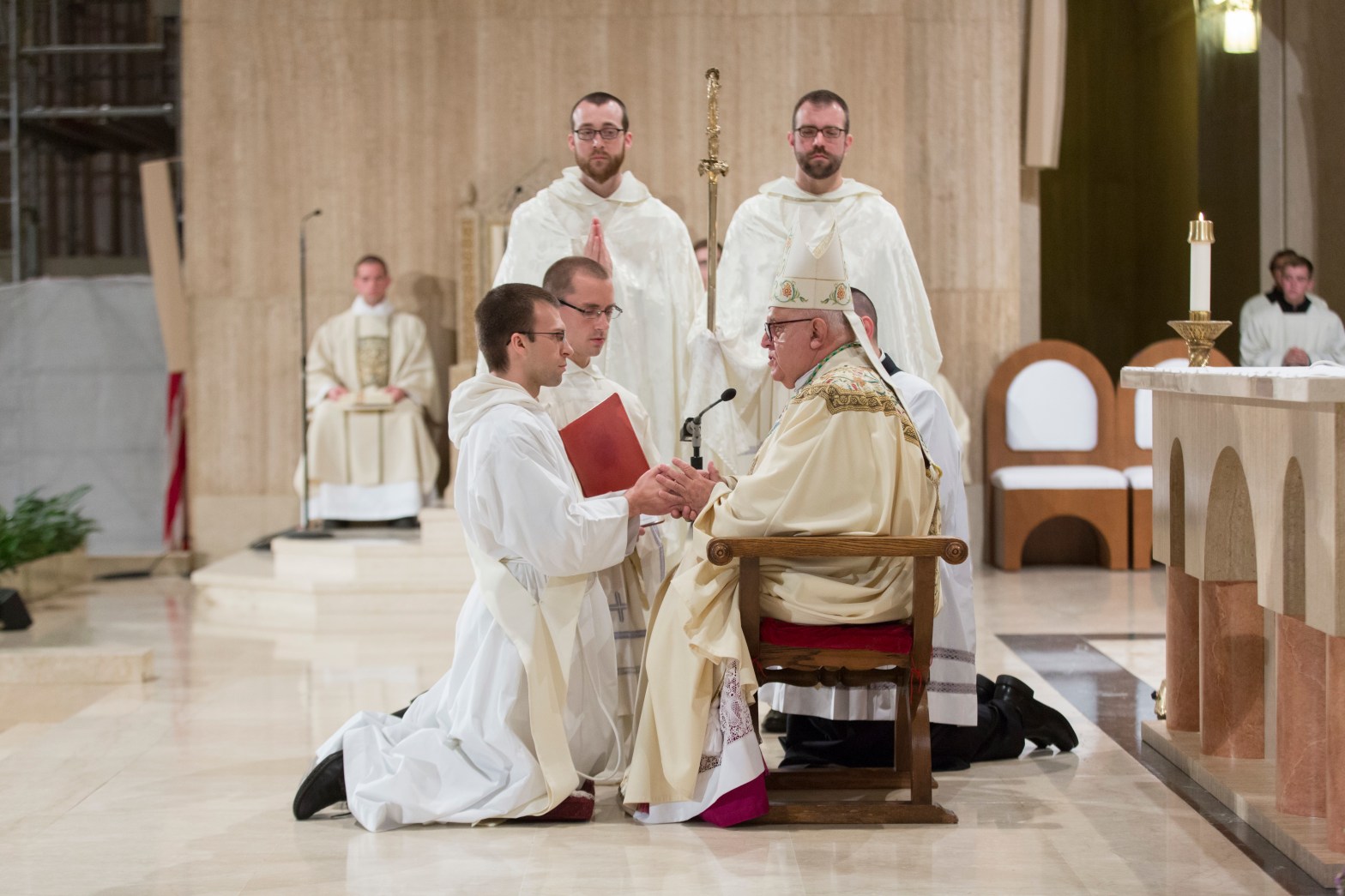
It is no surprise that the Roman Catholic Church does not recognize the ordination of Anglican deacons, priests, and bishops. After all, when Henry VIII broke the English Church away from the Pope and placed it under sovereign control, the idea that the Roman Catholics would continue to see Anglican orders as valid seems foolish. Wasn’t the English Church now under heretical rule?
Actually no.
It had been a long-standing tradition in the Church to recognize all orders as valid provided they were conferred by bishops who themselves had valid orders and conferred with appropriate ceremony. Ordination is a process that began in Biblical times with the Apostles who were commissioned and sent out (apostle literally means “one who is sent”) to preach the Good News. These Apostles themselves designated others as servants of the people, overseers of churches, and overseer’s assistants. These became the deacons, bishops, and presbyters or priests in later centuries.
The strict hierarchy that we see now in apostolic churches with a single bishop overseeing many priests and deacons appears to have arisen somewhere in the early to mid-2nd century. We see evidence of this in the letters of St. Ignatius in 110 AD, and certainly by the time of St. Irenaeus’s writings in 180 AD, the hierarchy was well-established.
The early church had many disputes between sects and there was a concern, of course, as to whether sins of heresy or any other kind of sin could invalidate the orders of a rogue bishop.
It was established early on that ordination itself cannot be taken away. This is why when a priest is “defrocked” only their permission to perform the duties of a priest is taken away, not their ordination. Indeed, all sacraments, validly performed, leave an “indelible mark” that cannot be taken away because this mark comes from the Holy Spirit and not human beings. St. Augustine argues this in the case of those who left the church to join the Donatists, a heretical sect:
For as those who return to the Church, if they had been baptized before their secession, are not rebaptized, so those who return, having been ordained before their secession, are certainly not ordained again; but either they again exercise their former ministry, if the interests of the Church require it, or if they do not exercise it, at any rate they retain the sacrament of their ordination; and hence it is, that when hands are laid on them,1149 to mark their reconciliation, they are not ranked with the laity. (“Against the Letter of Parenianus” https://www.ccel.org/ccel/schaff/npnf104.v.iv.iii.i.html)
More properly, do the sacraments that a rogue bishop or priest perform have any validity?
On this topic, St. Augustine argued that
it seemed good to the ancient authorities to reject the baptism of heretics altogether, but to admit that of schismatics, on the ground that they still belonged to the Church. (Letter CLXXXVIII: [Canonica Prima] to Amphilochius)
Thus, those whom he considered to be heretics such as “Manichaeans, of the Valentinians, of the Marcionites, and of these Pepuzenes” even if properly ordained before leaving the church could not perform valid sacraments, but if they simply left the church authority without necessarily being heretical then their sacraments were still valid.
The Roman Catholic Church canons effectively use these arguments from Augustine as well as later Doctors of the Church such as St. Thomas Aquinas to assert that schismatics such as the Eastern Orthodox Churches continue in apostolic succession and have valid sacraments.
When it comes to Anglicans, however, they assert that Anglicans lost their apostolic succession and therefore their sacraments are invalid (except for baptism which is the only sacrament that can be performed by laypeople).
Although the RCC maintained that they have rejected Anglican orders since the brief restoration of Catholic control of England under Queen Mary (1553-1558), it isn’t quite as clear as that.
The primary rejection of Anglican Orders comes from Pope Leo XIII who in 1896 commissioned a review of the long-standing rejection of Anglican Orders. The conclusion of the study was a letter Apostolicæ Curæ which interprets that the RCC position at the time of the English Reformation was that anyone ordained under the English Book of Common Prayer (BCP) at the time should be re-ordained in the RCC.
The Pope asserted that Anglican Orders are “absolutely null and utterly void”. This is based on the argument that the Edwardian BCP issued in 1552 changed the ordination rite, removing mention of the eucharistic sacrifice.
The 1896 letter further argued that since these concepts were not restored to the BCP until 1662 during the restoration of Charles II, apostolic succession had been lost.
Although this decision seems pretty definitive, we have known since 1978 that the commission examining the validity of Anglican orders was divided as to whether the English Church had maintained succession. Indeed, the RCC did not declare the Anglican orders to be null and void at the time of King Edward or Mary but only in 1704 when Pope Clement XI determined to reordain a priest (John Clement Gordon) ordained under the Edwardian rite. Moreover, it isn’t clear that during the reign of Queen Mary bishops, priests, and deacons were or had to be reordained.
Indeed, the Archbishops of York and Canterbury in a rebuttal of the letter in 1897 Sæpius Officio argued that there were several ordination rites used in the history of the church, particularly the early church, that were similar to the Edwardian rite. Therefore, the RCC position would render their own orders null and void!
Vatican papers that were opened in 1978 showed that Pope Leo XIII may have had other motives for rejecting Anglican orders. Essentially, the Pope was less interested in historical continuity than present agreement on issues of sacramental theology and ecclesiology, including some recognition of the papacy. He by no means wanted to end the dialogue between the RCC and the Anglican Communion and indeed it has continued to this day.
The dialogue between the Anglican and RCC continued after Apostolicæ Curæ. There was some excitement that during Vatican II some reversal of Pope Leo’s decision would occur but if anything there was more polarization. There were many suggestions for how and why Anglican orders might be considered valid within the renewal of RCC theology taking place.
For example, in many cases, the RCC returned to traditions of the early church, such as the understanding of the ordination of a bishop as different from that of a priest, that the Anglican Communion had already adopted.
Vatican II also introduced reforms in the ordination rites in the RCC that removed some medieval additions. This made the RCC rites more like the Anglican rites as well.
By the 1980s, there was a suggestion that mutual recognition might be possible regardless of historical differences if there were some official approval from the Anglican church on agreements between the Anglican Communion and the RCC on sacraments and the nature of ministry. Some of this was achieved at the 1988 Lambeth conference when the Anglican Communion voted to approve the statement “the Eucharist is a sacrifice in the sacramental sense”. Twenty-five of the twenty-seven Anglican Provinces at the time also accepted the conclusions of the Anglican–Roman Catholic International Commission (ARCIC) on the eucharist, priesthood, and ordination.
Nevertheless, in 1998, Pope John Paul II reaffirmed the conclusions of Apostolicæ Curæ and declared the matter closed and that denial of those conclusions would be considered “rejecting a truth of Catholic doctrine and [anyone doing so] would therefore no longer be in full communion with the Catholic Church”.
If anything, the Anglican Communion and the RCC have only grown further apart since then.
The theory of apostolic succession is an important one, but it has never really been about lineage. Rather it is about holding to the truth of the faith as far as sacramental theology and the role of priests.
What does this mean about Anglican orders?
As far as Anglicans are concerned our orders are valid and in apostolic succession. We do not consider that we somehow deviated from the historic continuity of the church in 1552.
But, continuing to harp on succession is a dead-end method of rapprochement between Anglicanism the RCC, and, for that matter, Eastern Orthodoxy which is really the whole point of examining the question.
The reality, however, is that the present age may either push the traditions together or force them apart depending on whether and how they cave to the pressures of this world to conform or see one another as an ally in the battle against rising secularism. I am praying for the latter.


A Sacrament to be valid requires the proper Intent. In order for the Sacrament of Ordination to be valid, it requires that the main purpose of a priest be acknowledged. And that purpose is Sacrifice. The Sacrifice of the real Body and Blood of Christ, on the Cross, must be offered as Propitiation for the Sins of the People. For heretical Protestants, such as Anglicans it is a mere Memorial of the Last Supper. Orthodox and Catholic priests metaphysically bring you back to the exact moment of the Crucifixion, so you relive it and die on the Cross as Christ and in Christ’s Body. The Communicant, using the Priest, offers himself in his sufferings and crosses in Life for Christ, In Christ, and dies in Christ. And the Communicant, in turn, using the priest’s Sacrificial authority, offers himself/ herself as Sacrificial Victim for his/her sins, and the sins of the whole world. In order to Rise from the Dead with Christ, one needs to Die in Christ’s Body with Christ. Only those in Christ’s Death can experience Christ’s Resurrection.Reply
LikeLike
You should read the article. Not all protestants believe the same thing.
LikeLike